
Agriculture

Randy grew up working on farms, frequently walking beans and doing chores. His in-laws run a livestock and crop farm in Sioux County, where he helps out along with his wife and four kids – spending many weekends bailing hay, loading hogs, vaccinating cattle, and maintaining seven finishing sites.
He knows first-hand that corn and soybean growers -- along with our livestock, egg, dairy, poultry, ethanol, and biodiesel producers -- form the backbone of the 4th District’s economy. As the second largest ag producing district in the country, Randy serves as a voice for Iowa's hardworking farmers, giving them a seat at the table on the House Agriculture Committee.
For more information concerning work and views related to Agriculture, please contact our office.
More on Agriculture

WASHINGTON, D.C. – Today, U.S. Rep. Randy Feenstra (R-Hull) voted for, and the U.S. House of Representatives passed, the Beagle Brigade Act.
WASHINGTON, D.C. – Today, U.S. Rep. Randy Feenstra (R-Hull) and several of his colleagues on the U.S. House Ways and Means Committee released a request for information from relevant stakeholders on biofuel tax policy.
HULL, IOWA – Last week, U.S. Rep. Randy Feenstra (R-Hull) helped introduce legislation – led by U.S. Rep. Trent Kelly (R-MS) – to help deliver financial relief to American farmers facing low commodity prices and high input costs this crop year.
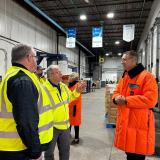
On October 14th, I kept my 36 County Tour going in Crawford County – honoring my promise to meet with Iowans in every county in the 4th Congressional District at least twice a year. Since beginning my 36 County Tour, I have been to Crawford County eight times—with each visit as interesting and informative as the next.
HULL, IOWA – Last Friday, U.S. Rep. Randy Feenstra (R-Hull) helped lead a letter with U.S. Senator Chuck Grassley (R-IA), U.S. Rep. Brad Finstad (R-MN), and U.S. Rep. Derrick Van Orden (R-WI) to U.S. Secretary of Agriculture Tom Vilsack demanding answers about the U.S. Department of Agriculture’s 2022 approval of nearly $46 million in taxpayer dollars for Pure Prairie Poultry and its subsequent bankruptcy in late September.
While I’ve been out on the road traveling from town to town on my 36 County Tour, the sights and sounds of this year’s harvest are on full display. Combines, tractors, and grain carts dot the fields, farmers are hauling their crops to market, and our farm families are preparing for winter. Our annual harvest serves as an important reminder that agriculture powers our economy and supports our rural communities.
Over the last few years, the agriculture economy has taken a turn for the worse. Commodity prices have fallen below producers’ break-even points, our agricultural trade deficit has eclipsed $43 billion, farm debt stands at a record $540 billion, and inflation combined with high interest rates continue to squeeze profit margins. A recent report from Purdue University also found that three in every four farmers expect conditions in the farm economy to deteriorate in 2025.

Since I was first elected, I have traveled to every county in Iowa’s 4th Congressional District at least twice a year. It’s a commitment that I made to my constituents that I would be transparent and accessible while taking their concerns, ideas, and suggestions back to Congress and offering meaningful solutions to the problems facing our communities, state, and nation.
HULL, IOWA — Today, U.S. Rep. Randy Feenstra (R-Hull) issued the following statement recognizing National 4-H Week:
On October 1st, the new President of Mexico – Claudia Sheinbaum – was officially sworn into office. While politics in Mexico may seem inconsequential to domestic affairs here in the United States, this development is very significant for our country, and particularly for our agricultural community.